

Reports & Finance
Reports & Finance give your organization visibility into daily business performance and financial operations.
Rather than replacing accounting software, Reports & Finance help businesses monitor operational performance, reconcile cash, identify discrepancies, and review financial activity generated through everyday bookings.
This guide is intended for business owners and administrators responsible for monitoring business performance.
Understanding Reports
Section titled “Understanding Reports”Reports bring operational data together into meaningful business insights, that help you understand revenue, cash movement, and overall business activity. These insights support better day-to-day decision making while reducing manual reporting.
Revenue Overview
Section titled “Revenue Overview”Revenue metrics provide visibility into the financial performance generated through bookings. They help managers monitor trends over time and better understand business growth.
As your business grows, these reports provide a centralized view of financial activity across the organization.
Cash Reconciliation
Section titled “Cash Reconciliation”Cash reconciliation helps verify that recorded transactions match the cash handled during daily operations.
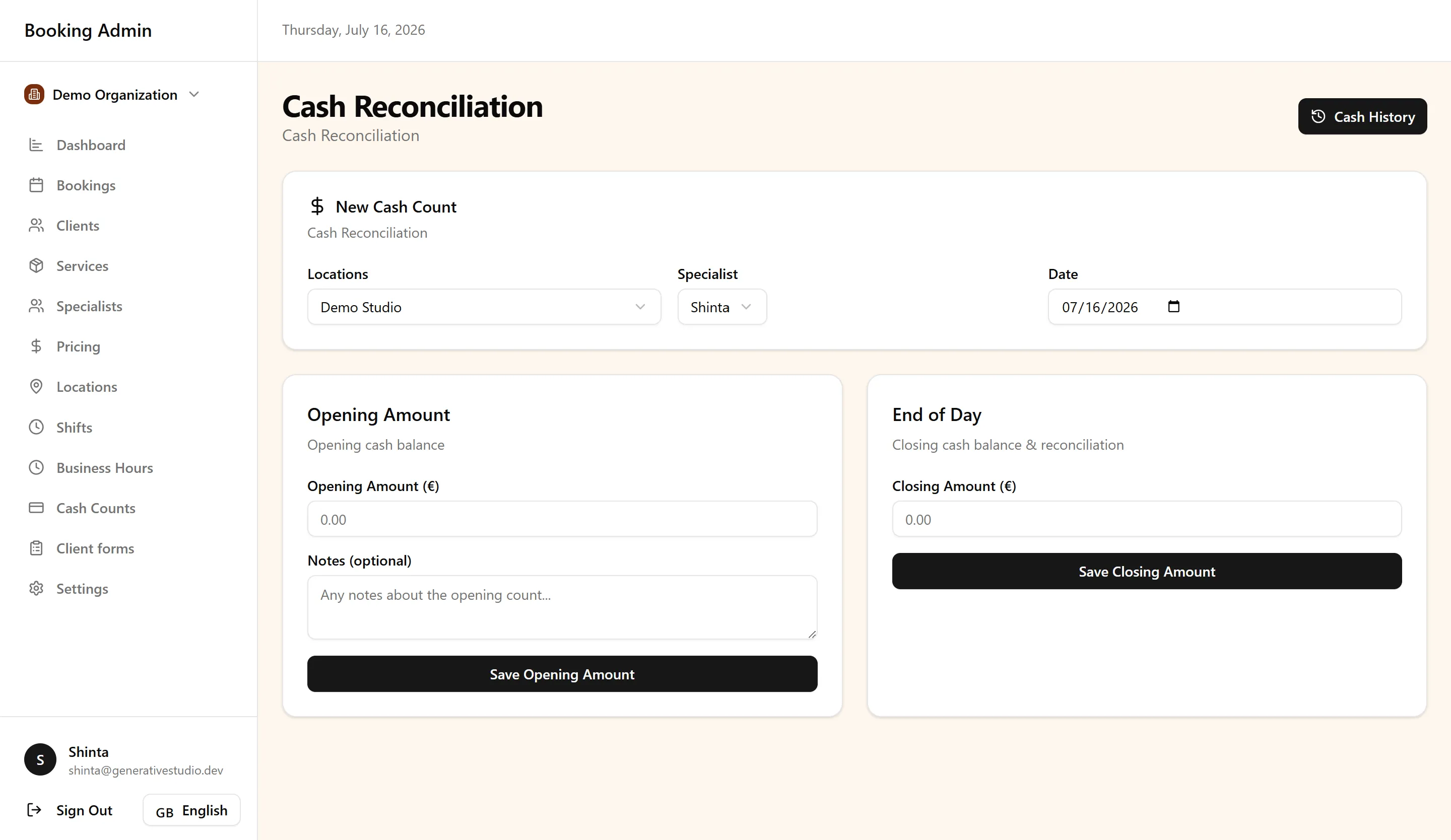
By comparing expected cash with the recorded cash balance, businesses can identify discrepancies before closing the day.
Historical reconciliation records also provide an audit trail for reviewing previous cash counts and operational activity.
Opening & Closing Cash Balance
Section titled “Opening & Closing Cash Balance”Each operating day begins and ends with recorded cash balances.
Recording opening and closing cash balances helps maintain accurate daily cash records and supports reliable reconciliation.
When a specialist submits Opening Flow, the opening cash amount is written to Cash records. When a specialist submits Closing Flow, the closing cash amount is written to the same Cash records for that specialist, location, and date. Administrators can review the related opening or closing report for the specialist, location, submission date and time, cash amount, daily meter readings (when configured), checklist answers, required details for No answers, stock usage (closing only, when recorded), and additional notes.
Financial Reporting
Section titled “Financial Reporting”Financial reports help businesses review overall performance without manually collecting information from different parts of the platform.
Available reporting may include:
- Revenue metrics
- Cash reconciliation history
- Opening and closing balances
- Cash discrepancy tracking
- SMS usage tracking
How Reports & Finance connect to the platform
Section titled “How Reports & Finance connect to the platform”Reports & Finance bring together information generated across FullDay. Bookings provide operational activity, clients contribute long-term business history, and platform usage—such as SMS activity—is incorporated into reporting where applicable.
Because reports are based on real operational data, they always reflect activity occurring across the platform.
Best Practices
Section titled “Best Practices”To keep reporting accurate and reliable:
- Complete cash reconciliation at the end of each operating day.
- Investigate discrepancies as soon as they are identified.
- Review financial summaries regularly to monitor business performance.
- Keep operational processes consistent across locations. – Use reports to identify trends and support informed business decisions.
Next Steps
Section titled “Next Steps”Continue exploring related parts of the platform:
-
Booking Management — Learn how bookings generate the operational data used in reports.
-
Clients — Understand how client activity contributes to long-term business insights.
-
Locations & Organization Settings — See how organization structure supports reporting across multiple locations.
-
Opening Flow: Learn how specialists record opening cash and salon conditions at the start of the day.
-
Closing Flow: Learn how specialists record closing cash, closing checks, and stock usage at the end of the shift.
-
Billing & Subscriptions — Learn how subscription management supports your organization’s operations.
For common questions about Reports & Finance, see the FAQ.